

Our tongue bestows upon us the luxury to savour the food we eat.
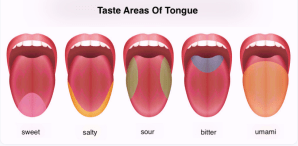
It does so through the presence of thousands of taste buds on its surface to perceive tastes, including sweet, salty, sour, bitter and umami. Taste buds let us know what we’re eating and drinking and whether it tastes good or bad. Good makes eating pleasurable, which helps keep our body nourished. Our taste buds also alert us when something isn’t safe to consume, like spoiled milk or rotten meat, saving us from falling sick.
But that’s not the only function our tongue has been assigned! As an important part of the digestive system, our muscular tongue is also essential for moving around, chewing and swallowing the food we ingest.
It also helps us make different sounds so we can speak and form words clearly, and keeps our airway open to breathe properly.
Does the tongue tell something about our health too?
Our tongue is the spokesperson of our health. Since it is linked to many of our vital organs, any variations in its color, coating, size, shape, texture or movement can provide clues as to what’s going on within.
Learn to decode what shows up on your tongue for a quick view inside your body:
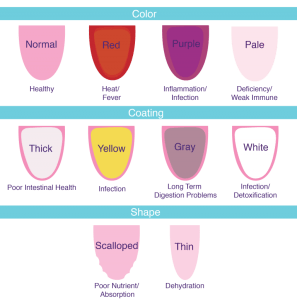
Color
- A pink tongue is healthy and normal.
- A red or crimson tongue may indicate heat in the body like with fever or inflammation, or a hormonal imbalance.
- A reddish-purple tongue could indicate an inflammation, an infection, poor circulation or cardiovascular issues.
- A pale pink or white tongue may suggest anaemia, a lack of blood circulation, a vitamin deficiency, or a weak immune system.
Coating
- A thick heavy coating reflects poor intestinal health or digestive issues. Caused by excessive pathogenic fluid, it also indicates poor digestion.
- A yellowish hue on the tongue can signify a buildup of bacteria due to an infection in the body or food particles. It may also indicate digestive issues or liver problems.
- A grey or blackish coating indicates a long-term digestive disorder or that something may be very wrong with your body’s health.
- A thick white coating is probably an oral thrush – a yeast infection or might indicate poor circulation to the extremities.
Shape
- A swollen tongue might indicate fluid retention or oedema. If the tongue is puffy with scalloped edges or indented teeth marks it may indicate malabsorption of nutrients or a weakened spleen.
- A very thin tongue can be a sign of dehydration.
Size
- Microglossia, an abnormally small or atrophied tongue may result from malnutrition or neurological disorders.
- Macroglossia or an abnormally large tongue may be congenitally present in individuals with acromegaly (think of the wrestler – The Great Khali) and is typically first noticed when the individual is an infant. New-onset macroglossia in an adult is pathognomonic for amyloidosis – a rare disease that occurs when a protein called amyloid builds up in organs including the tongue. It can also be a sign of hypothyroidism, an infection, or allergies, among others.
Texture
- A fissured tongue is common in dry mouth (hyposalivation), and its prevalence in liver disease is around 30–40%. Transverse furrows across the tongue may result from scrotal tongue – a benign condition. Furrows that are longitudinal along the length of the tongue are the result of syphilis.
- A smooth tongue is caused most commonly by the use of dentures. Nutritional deficiencies including iron, folate and vitamin B12 can also result in a similar tongue, as their deficiency can cause inflammation of the tongue (glossitis), making it appear sore, swollen and beefy-red. Among women, low-estrogen states may cause a “menopausal glossitis” with a similar tongue. A smooth atrophic tongue is typical in Alcohol-related liver disease (ARLD) and is significantly associated with liver transplant candidates.
- A geographic tongue (GT) is a benign condition in which discolored, painless patches on the tongue appear from atrophy and then reappear, often in a different distribution. Seen in about 1-3% of the population it occurs more frequently in women than men, and in adults than children. It finds its association with several systemic diseases including atopy (a hyperimmune response), allergy, asthma, stress, eczema, psoriasis, hormonal changes, vitamin deficiencies, and syndromes such as Down syndrome.
- A tongue with recurrent painful aphthous ulcer(s) can result from systemic illnesses such as Crohn’s disease, ulcerative colitis, pemphigus, herpes simplex, reactive arthritis etc. or it can be a drug reaction. A single non-healing, erythematous, painful ulcer suggests lingual or oral cancer, particularly if someone is addicted to tobacco or alcohol.
- A hairy tongue with white hair along the sides of the tongue is a classic appearance of oral hairy leukoplakia in HIV-positive individuals. A black hairy tongue is often a fungal overgrowth, particularly of aspergillus with prolonged administration of the drug penicillin.


Movement
When our tongue is at rest, the tip of the tongue should always touch the roof of the mouth, just behind our front teeth and not low on the floor of the mouth. Anything beyond the six normal movement patterns of the tongue (suckling, simple tongue protrusion, sucking, munching, tongue tip elevation and lateral tongue movement) need immediate medical attention.
- Hypoglossal or 12th nerve palsy is damage to the hypoglossal nerve (which controls the muscles of the tongue), causing paralysis of the tongue. Usually, one side of the tongue is affected, and when the person sticks out his or her tongue, it deviates or points toward the side that is damaged. A normal person’s tongue would stay central when pulled out.
- Tongue-tie, an apparent microglossia present at birth, is a condition wherein a short, tight band of tissue tethers the tongue’s tip to the floor of the mouth thereby restricting the tongue’s range of motion. It can affect how a child eats or speaks and can interfere with breastfeeding as well.
- Fasciculations or visible, involuntary twitchings of the tongue are indicative of nervous system injury or sclerosis and may present with dysarthria (difficulty speaking) or dysphagia (difficulty swallowing) and need to be handled neurologically.
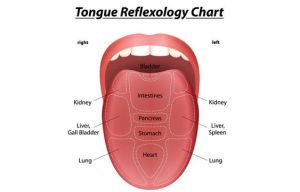
Interestingly, if we go by reflexology, different areas of the tongue correspond to different organs in the body for Chinese Acupuncturists to treat systemic illnesses. The illustration below represents the corresponding organs when looking at your tongue in a mirror.
While tongue diagnosis typically does not stand alone for diagnosing health conditions, the appearance of your tongue does provide some valuable diagnostic information to your healthcare professional.
Your physician will typically rely on a combination of medical history, physical examination, laboratory tests, and imaging studies for diagnosing and treating the root cause of your ailment.
A woman in her early sixties approached me in a state of paranoia a couple of days ago when her tongue looked abnormal to her. It had a thick pale greenish coating but what bothered her the most were the indentations on the sides. The prominent imprints of teeth (with a whitish discoloration) had been persisting for a few months. The first thing she asked me was “Is it not cancer?”
The Homoeopathic System of Medicine takes a highly individualized approach to the treatment of each and every case. A “Tongue Talk” can offer insight into your overall health and into specific issues. Different colors, coatings, shapes, sizes, and textures are known to associate with specific homoeopathic remedies since these formulations, upon clinical trials on humans, do present with different types of tongues. The findings have been reaffirmed through repeated clinical trials across centuries.
Undoubtedly, our tongue mirrors our systemic conditions and says it all!
 Dr Renu Madan