
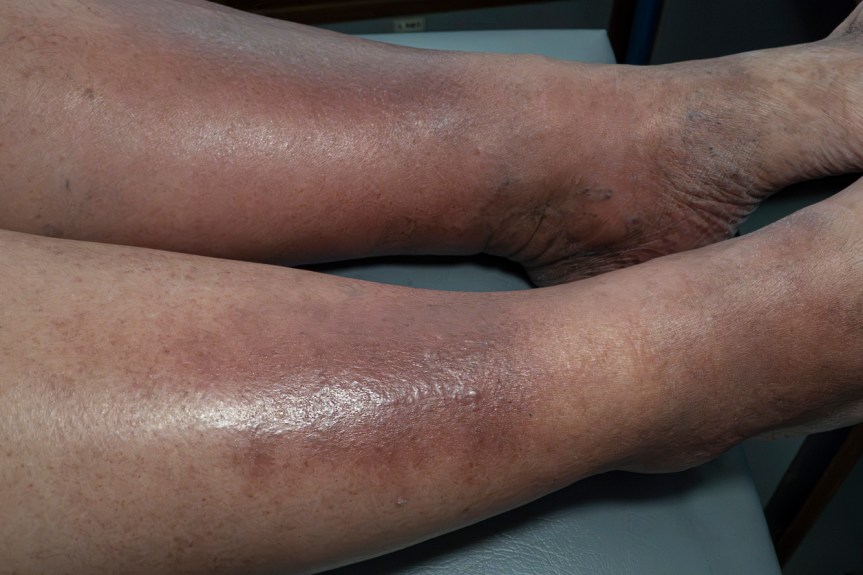
A form of eczema caused by poor blood circulation in the lower legs.
Stasis means slowed down or impeded, while dermatitis refers to inflammation of the skin. Stasis dermatitis is a chronic inflammatory skin condition that happens when you have poor or slowed blood circulation, primarily in the lower legs.
Also known as gravitational dermatitis or venous eczema, the condition develops when the veins in your legs fail to return blood efficiently to the heart. As the veins weaken or their valves become “leaky,” blood tends to stagnate in your lower limbs due to Earth’s gravitational pull. The venous insufficiency further allows fluid, including water and blood cells from the veins, to pool in the skin of your ankles and shin, causing them to swell.
Over time, the pressure and stretching resulting from this fluid buildup can cause inflammation and local skin symptoms.
These changes typically begin on the inside of your ankles and gradually spread to the rest of your feet.
Stasis dermatitis mainly affects older adults and is considered a skin manifestation of chronic venous insufficiency.
What does it look like?
Stasis dermatitis most often affects the ankles and lower shins on one or both legs. It can appear on other parts of the body, though it is uncommon. The main signs and symptoms include:
# Discoloration of skin around the ankles, shins, or lower legs, on one or both lower limbs, is the most common sign to look out for. Orange-brown speckles of discoloration, known as cayenne (kay-en) pepper spots, can develop when pressure and swelling cause capillaries—the smallest blood vessels around your ankles, shins, or lower legs—to burst. The red blood cells leak out of the pooled vessels, break down, and leave iron deposits in the skin. Over time, this accumulation leads to a characteristic discoloration that can range from red to yellow or dark, muddy brown, depending on your skin tone.
# Dryness, Itching and Irritation: A persistent, often intense itch is common. The skin may feel very dry or tight.
# Swelling (Oedema): Legs or ankles may swell, especially after standing. This can create a feeling of heaviness or achiness.
# Scaling or Flaking: The skin may flake, peel, or become scaly as it dries out.
# Pain or Tenderness: A heavy, achy or tingling feeling, particularly after long periods of sitting or standing, is commonly felt in the affected area.
# Crusty, Thickened or Hard Skin: The affected skin can become hard, leathery, crusty or weepy, oozing out (exuding) foul-smelling pus.
# Scarring: Fibrinogen, a constituent of blood that helps in blood clotting, can leak out and form “fibrin cuffs” around blood vessels. This leads to significant thickening or scarring, which can eventually change the shape of your legs. As a result, your legs may take on the appearance of an “upside-down bowling pin” or an “inverted champagne bottle,” with a noticeably shrunken lower calf. (The image on the right is used for reference only.)

# Open Sores or Venous Ulcers: In serious cases, wounds – that may take the shape of open sores or venous ulcers can form. They may further ooze, crust over or become infected.
Severe stasis dermatitis can cause permanent skin changes, including thickening, hardening, darkening or a bumpy, cobblestone-like appearance.
Who gets stasis dermatitis and why?
While not everyone with venous insufficiency develops stasis dermatitis, poor circulation certainly heightens the risk.
- People over the age of 50 are most prone since ageing contributes to poor blood circulation,
- Women are more likely to get it than men. Pregnancy, multiple pregnancies, in particular, are linked to a higher risk.
- Certain medical conditions or comorbidities can increase your risk of developing stasis dermatitis – a history of blood clots (deep vein thrombosis) in the leg veins, high blood pressure, congestive heart failure, cellulitis, varicose veins, obesity and kidney disease.
- You also get prone to developing stasis dermatitis if you have had leg injuries (broken leg), surgeries (knee replacements, hip surgery, etc.) or radiation to the legs due to disruption of the leg veins.
- Certain lifestyles and occupations can raise the risk. One significant factor is extra weight or obesity. Jobs that require prolonged periods of standing or sitting, such as desk jobs, driving, teaching, and similar roles, combined with a lack of exercise, can slow down the blood flow, thereby raising the pressure in the leg veins.
Is it contagious?
No, not at all. You can’t “catch” it or spread it to others.
How is it diagnosed?
We doctors usually diagnose stasis dermatitis through a physical exam and a history of venous problems. Key steps include:
Clinical Exam: Usually, a glance at your leg’s skin health and enquiring about symptoms and risk factors, such as varicose veins or past blood clots, is sufficient. The typical discoloration, dryness, and location around the ankles often point towards stasis dermatitis.
- A CT scan or ultrasound (Duplex Scan): A Doppler ultrasound of the legs is often done to assess blood flow. It can detect blood clots, show how well the leg valves work, and confirm venous insufficiency.
- Blood Tests: These aren’t usually needed for stasis dermatitis, but might be done to check for underlying issues, such as testing for heart or kidney function.
- Allergy or Patch Test: If your doctor suspects that your rash is from an allergy to some soap, lotion, fabric, shoe, etc., a patch test can be done to rule out allergic contact dermatitis.
- Skin Biopsy: Though done rarely, it may be used to rule out other skin diseases.
What are the treatment options?
Since the exact reason why stasis dermatitis forms in some people with poor blood circulation but not others is unknown, most treatments focus on managing symptoms and avoiding future flares. There is no one-size-fits-all treatment for the condition. The best treatment depends on your specific case and treatment preferences.
Conventional medical treatments for stasis dermatitis include:
- Corticosteroids, oral and/or local, to calm inflammation and reduce skin discoloration
- Topical or oral antibiotics if your skin is infected
- Antihistamines to help with the itch
- Topical creams for alleviating pain
- Intense pulsed light treatments to help reduce skin discoloration
Topical Corticosteroids can help reduce inflammation and itching during flare-ups, but long-term usage can thin the skin. Steroids do not fix the underlying cause but help control symptoms.
To treat the underlying venous disease, your vascular specialists may recommend venous procedures like:
- Sclerotherapy or Laser Ablation to seal off the malfunctioning veins and stop the backwards blood flow using minimally invasive techniques.
- Vein stripping or Ligation – a surgical removal or tying off of the damaged veins, though less common nowadays, may be done in severe cases.
- Cosmetic or Reconstructive Surgery, a more extensive vascular surgery, is applicable for large varicose veins or very severe cases.
How can I prevent stasis dermatitis flares?
Possible self-care measures and lifestyle modifications to help improve blood flow in the legs, reduce swelling and heal the skin include:
- Use supportive elastic stockings or bandages for most of the day. They should fit well (often graded by millimetres of mercury). These compression garments, as the name suggests, exert gentle pressure on the legs, which helps push blood upward and reduces swelling. You can find significant relief from pain and swelling by using them daily.
- Elevate your legs above the heart every two hours to help reduce swelling. Even lying flat with legs on a stack of pillows can ease fluid build-up.
- Avoid prolonged standing or sitting. If you have a job or habit of standing or sitting for hours, take regular breaks – ideally, these breaks should be active rather than sitting still. Even a few minutes of walking or leg movement can keep the blood circulating.
- Exercise regularly. Gentle exercises such as walking, leg lifts or simple calf muscle exercises can make a difference by pumping blood through the leg muscles to keep your veins healthy.
- Avoid foods high in salt to minimise fluid retention.
- Avoiding irritants such as grass, pet hair, plants, products with fragrance and cleaning products/detergents.
- Maintain a healthy weight to reduce pressure on the legs.
- Quit smoking as it worsens your blood circulation.
- Eat a balanced diet rich in fibre to avoid constipation (straining can increase leg vein pressure).
- Use moisturisers (emollients) to keep skin well-hydrated, at least once daily (more if very dry). Thick, fragrance-free lotions or ointments help control itching, prevent cracking and avoid infection.
Adding these measures to the prescribed medical treatment can help control your symptoms to a large extent, reduce flare-ups, and prevent serious long-term complications such as chronic leg ulcers, bacterial infections (cellulitis), lymphedema, or deep vein thrombosis (DVT) – which can be life-threatening if the clot from the leg veins travels to the lungs/heart/brain.
Can Homoeopathy help?
A 63-year-old man visited my clinic in 2019, limping, complaining of pain in his left ankle. He had been experiencing this pain for the past 3 weeks. His ankle showed all the signs of water retention, with a fairly swollen ankle (we call it pedal oedema). The pain was probably due to the infection, which had set in as he was oozing out lots of pus. The skin around the ankle showed typical signs of stasis dermatitis. It was thick, dry, rough, hard, dark and hyperpigmented. He was a known diabetic for the past 6 to 7 years and suffered from altered sensation of numbness in both feet consequent upon DM. The swollen foot had an extremely foul-smelling pus oozing out from wherever it could break the skin.
The family feared an amputation due to long-standing diabetes if not controlled in time.


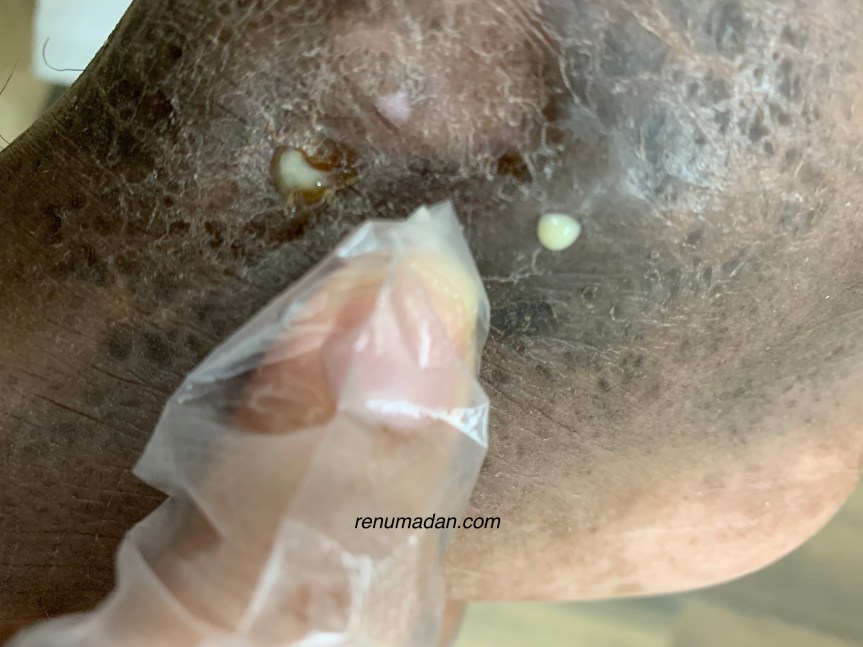
He exhibited more at-risk factors than just suffering from diabetes. He was a chain smoker (smoked 40-50 cigarettes a day), and suffered from alcoholic liver disease with deranged liver and kidney function markers for years.
The picture below was taken after 3 weeks of Homoeopathic medication and lifestyle modifications. The oedema had markedly reduced, the oozing had stopped, the lesion had dried up considerably, and the unbearable foul smell was almost gone. The patient walked in comfortably to my chamber.

He was kept on medication for nearly a year and a half.
The patient-doctor relationship in Homoeopathy is truly remarkable, more so if you are in private practice. It kind of simulates the olden days when general practitioners (GPs) or healthcare providers would know families for generations. Over time, their children, often future doctors, would inherit the practice and continue to care for your family’s health. Since the cumulative time they get to invest in your health issues over the years is significant, they get well-versed with your dispositions, medical history, and familial tendencies. For nearly all Homoeopathic practitioners, it’s not one but MULTI members in the family that come for consultation, often across many generations.
The same long-standing association allowed me to reach out to this patient after a significant gap to inquire about his foot condition for a final follow-up (just in case his stasis dermatitis flared up again) and request a photograph. He was more than happy to oblige. This is how his foot looked post the final cure.


*********
 Dr Renu Madan