

Smoothly raised, red, itchy bumps or welts on the skin, often with a blanched centre; varying in size from as small as a pencil tip to as large as a dinner plate.
The allergic rash of Hives (urticaria or छ्पाकी) can initially simulate a mosquito bite but these itchy bumps may soon connect or coalesce to form larger welts, hence the name HIVES (a large group of itchy, red bumps packed in a space like a swarm of bees in a bee-hive).
Hives may sting or hurt sometimes.
Hives are common and can flare up suddenly. They can change size and shape rapidly and move around, disappearing in one place and reappearing in another one, often in a matter of few hours. An outbreak that looks impressive, even alarming, first thing in the morning can be completely gone by noon, only to be back in full force later in the day.
An individual hive usually lasts no longer than 24 hours, but new hives may appear as old ones fade, making an episode last for maybe a few days or longer. If a bout of hives lasts for less than six weeks, it is called acute hives. If the same lasts for more than six weeks, it is classified as chronic hives.
A swelling deeper in the skin that may accompany hives is called angioedema. This swelling, either of the hands and feet or the face [lips or eyelids], can be as dramatic as it is brief. In rare cases, serious angioedema can cause your throat or tongue to swell and block your airway, making it hard to breathe or swallow. If this occurs, the person needs emergency care right away.


Why does one get hives?
An allergic reaction can trigger hives in you. It causes your body to release chemicals like histamine from the mast cells present in the skin. Histamine causes fluid to leak from the local blood vessels, making your skin swell up.
People prone to other allergies are more likely to get hives. Since hives are the work of an over-driven immune mechanism, they are not contagious.
Things that commonly trigger an allergic reaction could be:
- Foods: fruits (especially citrus fruits), milk, eggs, peanuts, tree nuts, shellfish, wheat, soy or added colors/preservatives in foods
- Insect bites and stings
- Worm infestations like roundworms, hookworms or tapeworms in your gut
- Animal fur or dander [protein in their saliva/urine]
- Pollen
- Touching something you are allergic to such as latex, certain chemicals etc.
- Medications: morphine, codeine, anticonvulsants and non-steroidal anti-inflammatory drugs (NSAIDs) such as aspirin, ibuprofen, nemulid etc.
Less common causes of hives include:
- Infections including colds and infections caused by certain bacteria or fungi
- Certain illnesses including a type of vasculitis, lupus, and thyroid disorders
- Adrenergic: Reaction to adrenaline/noradrenaline allergy shots (extremely rare)
- Stress: The reason why stress seems to precipitate an outbreak in many people is not completely understood but is likely related to the known effects of stress on the immune system
Hives can happen within minutes of exposure to the trigger or you can have a delayed reaction of more than two hours.
Physical urticaria is a chronic form of urticaria as a result of direct physical stimulation by environmental forces like:
- Heat (cholinergic) – while exercising or doing physical exertion, mostly in young people,
- Cold – caused by ice, cold air or water,
- Sudden temperature change – going from a warm to cold or cold to warm environment,
- Sunlight (solar urticaria) – more common in fair-skinned,
- Water (aquagenic),
- Delayed pressure on the skin – such as from sitting too long.
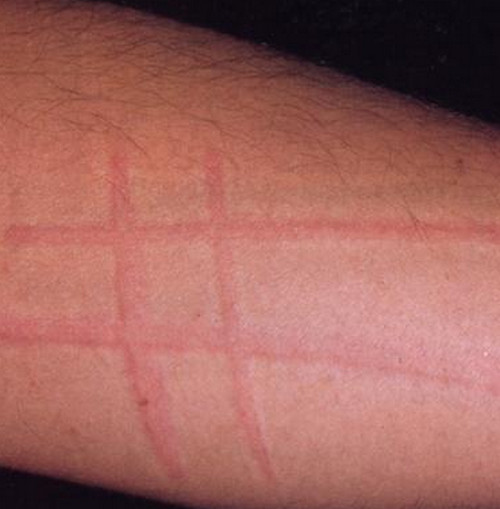 Dermographism or Skin Writing
Dermographism is another form of physical urticaria that exhibits an exaggerated form of what happens when your skin is scratched or rubbed. Raised, itchy red welts with adjacent flares appear wherever the skin is scratched or where belts and other articles of clothing like bra straps or elastic bands on undergarments rub against the skin, causing mast cells to leak histamine.
How are hives diagnosed?
Very few skin diseases occur and resolve so rapidly. Therefore, even if you have no evidence of hives to show when you get to your doctor for examination, a diagnosis can be established based on the accurate recounting of your symptoms and signs. As hives fluctuate so much and so fast, it is helpful to bring along a picture of what the outbreak looked like at its most severe point.
Finding the cause of hives can be another challenge (This is especially true for hives that have been around for more than six weeks). If you aren’t certain what is causing you hives, talking to your physician can help you identify potential allergic triggers. S/he will review your health history, ask questions, and do a physical examination. Your doctor can also order the following blood or skin tests for allergies:
- Allergy tests (on the skin or blood tests).
- Blood work (to rule out an illness or infection).
- A skin biopsy (in a few cases).
Hives: Personal care tips
Since hives are so common and acute urticaria, by definition, resolves spontaneously, doctors do not generally expend much time or expense to evaluate the cause of hives of less than eight weeks duration. The goal of treating most cases of ordinary acute urticaria is to give symptomatic relief until the condition gets self-limiting.
- In milder cases, applying cool compresses or having a cool shower may help soothe the itch of a hives rash.
- Keep your fingernails short to avoid scratching.
- Use gentle, fragrance-free soaps and avoid bubble baths or scented lotions.
- Moisturize liberally in dry or cold weather.
- Maintain a comfortable environment. Air conditioning is preferred in summer while it’s helpful to have a humidifier in winter.
- Dress up in comfortable loose clothes that are 100% cotton to help reduce sweat.
- Switch to a simple, bland diet and avoid tea, coffee or alcohol.
- The application of coconut oil might help relieve itching on the affected parts. The oil is known to have some medicinal effects in reducing local inflammatory response.
What is the treatment for hives?
Your dermatologist may prescribe anti-histamines, such as Allegra, Cetirizine, etcetera, in mild to moderate cases to relieve symptoms of itching, redness or swelling. The dosage can go up to three times a day, but since these medications can cause drowsiness, bedtime is their preferred time. When prescribed for chronic hives, a single dosage may suffice to prevent hives from forming. Those who take them should be careful and ensure they are fully alert before driving or participating in other activities requiring mental concentration.
Antibiotics like Dapsone can also help relieve redness and swelling.
Topical anti-histamine or menthol ointments provide a soothing effect.
In stubborn cases, your doctor may resort to corticosteroids like Prednisone [injection or pill], which work by suppressing your immune system. However, these can be administered only for a smaller duration. Long-term usage is known to have side effects.
Omalizumab is an injectable medicine that can help patients with chronic idiopathic urticaria (CIU), a type of hives that can last for months or even years if all other medications fail to help.
For some cases of hives or angioedema (where the swelling occurs deeper in the skin), you may need an injection of epinephrine (a shot of adrenaline). If you have hives and trouble breathing or swallowing, get emergency care right away.
Talk to your doctor about a prescription medicine called an “auto-injector.” This medicine stops the allergic reaction when you inject it into your thigh. Follow your doctor’s advice on how to use this medicine.
All these medicines help oppose the effects of the histamine leaked by mast cells for a short duration but have possible side effects and can get habit-forming. Thus after a significant period, one may require a higher dose or different medicine.
Homoeopathy for Hives
Homoeopathy offers a permanent cure for hives most gently and safely without any side effects. The scientific system of medicine has innumerable specifics for urticaria such as Apis mellifica, Astacus fluviatilis, Dulcamara, Ledum Pal, Natrum mur, Urtica urens, Antipyrin, Rhus Tox, Sepia, Sulphur and many more. The most accurate remedy is selected after a thorough case analysis including your medical history, physical and mental constitution, and your predispositions or susceptibilities. These medicines not only help relieve the discomforting symptoms but also wipe off your tendency for a hyperactive immune response to the substances in the environment, that pose as triggers [allergens] for you.
In my clinical practice of a little more than three decades, I’ve had the success of treating innumerable cases of hives of various causation and severity. Patients who had been on long-term anti-allergics or steroids could do away with them after a relatively short-term course of Homoeopathic treatment for a few months. Once cured, you can stop taking the Homoeopathic medicines altogether upon your physician’s advice. A recurrence is seldom observed.
 Dr Renu Madan