

Does your lil’ one snore or pause in their breathing while asleep? If yes, then in all likelihood s/he is suffering from enlarged adenoids…
Adenoids and tonsils are often talked about together. You can see your tonsils in the back of your throat, but what about your adenoids?
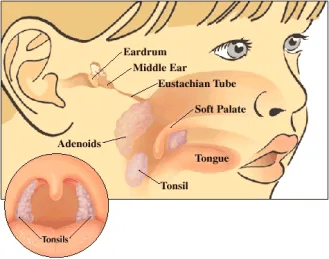
Adenoids are a patch of lymphoid tissue that sits higher up in the throat, just at the back of your nasal cavity. Akin to tonsils and lymph nodes, they too are a part of your immune system. Adenoids trap bacteria and germs that enter your body through the nose or mouth. The white blood cells circulating through them and other lymphoid tissue react to these foreign invaders and produce antibodies against them. This way, adenoids form a protective barrier to help your body fight respiratory tract infections, thus making them the perfect ‘Gatekeepers’.
Although you can easily see your tonsils by standing in front of a mirror and opening your mouth wide, it’s not the same with adenoids. Your physician can visualise them only by using a special mirror in the mouth or by inserting a flexible tube – an endoscope – placed through the nose. A side X-ray of the face (X-ray skull lateral view) can sometimes show enlarged adenoids. If unclear, your doctor may advise an MRI or a CT scan to get detailed images of your sinuses, nasal cavities, and adenoids.
Adenoids are crucial infection-fighters for babies and toddlers. However, they assume less significance once one gets older and his/her body develops other ways to ward off germs. We all have adenoids at birth and in childhood, but as we march into adolescence, they start to shrink. By adulthood, most people’s adenoids disappear.
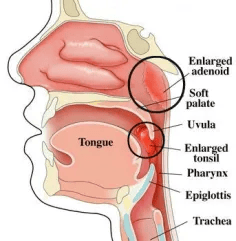
Since adenoids trap germs that enter the body, adenoid tissue sometimes temporarily swells as it tries to fight off an infection. This swelling generally subsides when the infection gets better, but sometimes adenoids can get infected themselves, leading to adenoiditis. When this happens, the tonsils too may get swollen. Swollen or infected adenoids can make it tough to breathe and cause problems, such as:
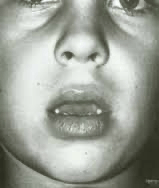
- a very stuffy nose, making the kid breathe only through his/her mouth. Breathing through the mouth may further cause bad breath, dry mouth, and cracked lips. There can be a persistent runny nose or nasal congestion. As a long-term implication of mouth breathing, there can be permanent changes in the facial shape – adenoidal facies – elongated face with an open-mouthed, slack-jaw appearance.
- snoring
- episodes of not breathing for a few seconds while sleeping (obstructive sleep apnea)
- swollen glands in the neck
- ear infections, as enlarged adenoids may block the Eustachian tubes, which drain fluid from the ears into the throat. Obstructed tubes can lead to repeated middle ear infections, ear pain (otalgia), and/or leaky ears (otorrhoea) in school-going kids, causing them to miss a lot of school. It can affect their hearing too.
Conventional Medicine offers antihistamines, antibiotics and/or nasal steroid sprays as first-line treatment in every episode of infection.
A possible removal (adenoidectomy) through curettage, cauterisation, laser, or ablation is recommended if the adenoids get large enough or if the symptoms are severe or persistent. Adenoidectomy may also be recommended if your child has tonsillitis that keeps coming back. But as with all operations, possible complications of surgery include infection, severe bleeding from the site whence the tonsils or adenoids were removed, or anaesthetic reactions.
Also, after the adenoidectomy, your child’s speech may become nasal. In a few, speech therapy or another surgery might be needed to narrow down the gap between the soft palate and the roof of the mouth for rectification.
Homoeopathic Approach: Removing the adenoids or tonsils is just like removing the ‘guards’ that often get attacked by infections while safeguarding us. It certainly is not a wise decision. Homoeopathy believes that wherever possible, tonsils and adenoids should be saved, as they are important defence tissues of our body and provide the children with the much-needed immunity relating to their respiratory tract. Homoeopathic medicines can be a great boon for the kids with these enlarged adenoids and tonsils, as not only do they cure the enlargements, but they also enhance the body’s resistance to fight recurrent infections.
Treatment with homoeopathy is carried out in two stages. Acute inflammation is treated with a particular set of medicines, and once the acute stage is over, the enlargement is treated with a different set. Homoeopathy offers a wide range of remedies such as Belladonna, Merc Sol, Merc Cynatus, Hepar Sulh, Hydrastis, Calcarea Phos, Agraphis nutans, Cistus Canadensis, etc., to name a few, to treat the acute infection. Also, if given judiciously, they help in restoring hearing loss due to catarrhal deafness too, by acting directly on the glands connected with the nasal cavity, and thus alleviating the obstructive symptoms. Deep-acting medicines – Tuberculinum, Medorrhinum, Thuja, Barta Carb, etc. are often required to treat the constitution of the child to bring about lasting relief. After a detailed ‘case-taking ’, your doctor will put you on a ‘Tailor-made’ remedy (constitutional remedy) that may help avoid adenoidal surgery!
Homoeopathic treatment is not only gentle for the kids but also has the added advantage of avoiding any infection or complications that may arise from surgery.
Note :: Do put your child on Homoeopathic Treatment for adenoids for at least a couple of months before you plan to go under a surgeon’s knife!

