
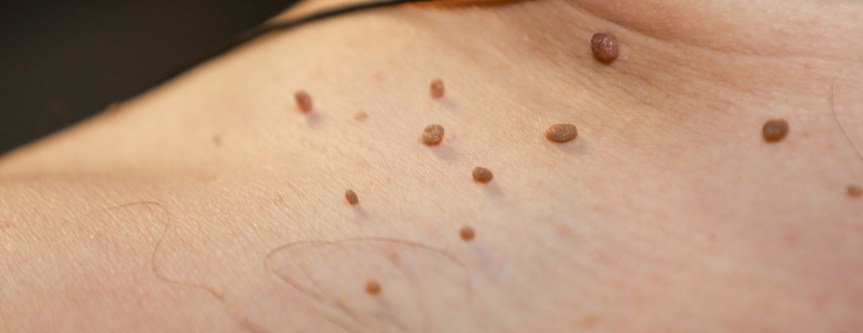
Warts are benign (noncancerous) growths that can develop in the top layer of your skin or mucosa (such as inside your mouth, nose, rectum, or anus). They are caused by an infection with the human papillomavirus (HPV). Out of over 100 subtypes (strains) of identified HPVs, only a few can cause warts on certain parts of your body.
All warts come from HPV, but not all forms of HPV cause warts. The type of HPV that can progress to cancer (like cervical cancer) doesn’t cause warts.
Although generally harmless, warts can be stubborn (difficult to get rid of). They can become bothersome when they either affect your self-esteem or make it difficult to do everyday things like walking or wearing shoes.
Some high-risk subtypes of HPV are associated with malignancies, including types 6, 11, 16, 18, 31, and 35. Malignant transformation is usually seen in patients with genital warts and in immunocompromised patients. HPV types 5, 8, 20, and 47 have oncogenic potential, leading to epidermodysplasia verruciformis.
Warts can occur at any age. Although rare in infancy and early childhood, prevalence increases among school-aged children and peaks at 12 to 16 years. The male-to-female ratio is approximately equal.
Warts are common worldwide and affect approximately 10% of the population. In school-aged children, the prevalence is as high as 10% to 20%. They are more common among immunosuppressed patients and meat handlers.
Warts often resolve on their own within a few years (about 65%). This mainly applies to people who have healthy immune systems. If you’re immunocompromised, warts probably won’t go away on their own; however, many treatment options can help you get rid of them.
Types of warts
Based on appearance, location and the HPV strain that causes them, they can be:
- Common warts (Verruca vulgaris): Rough, grainy bumps that can have black dots resembling seeds. These usually form on the fingers and hands. The black dots are actually smothered and dead capillaries. They range from the size of a pinhead to a pea. HPV types 2 and 4 most commonly cause them, ialong with types 1, 3, 7, 27, 29 and 57.
- Plantar warts: Hard, flat growths with tiny black dots that appear on the soles of the feet. They can become quite large and cause pain when you stand or walk. HPV types 1, 2, 4, 27 and 57 cause them.
- Mosaic warts: White and about the size of a pinhead, they typically form on the balls of your feet or under your toes. But they can spread and cover larger areas of your foot. Mosaic warts are flatter than plantar warts, and they only rarely hurt when you walk. HPV type 2 causes mosaic warts.
- Flat warts: These can develop anywhere on your body (face, neck, trunk, legs, or hands). They’re smaller, smoother, flat-topped lesions and tend to grow in large numbers, like 20 to 100 at a time. HPV types 3, 10 and 28 cause flat warts.
- Filiform warts: These warts look like long threads that stick out. They often grow on your face – around your mouth, eyes and nose. HPV types 1, 2, 4, 27 and 29 cause filiform warts.
- Genital warts: Moist, cauliflower-like growths that occur in the genital area, anus or rectum. HPV types 6 and 11 cause about 90% of genital warts. The infection is sexually transmitted through direct skin-to-skin contact and requires prompt medical evaluation.
- Butcher’s warts: These warts tend to develop on the hands of people who handle raw meat (like butchers) and those whose occupation involves frequent exposure to a cold, moist environment. HPV type 7 causes Butcher’s warts.
- Focal epithelial hyperplasia (Heck’s disease): A rare condition in which generally soft, whitish to mucosal-colored warts develop inside your mouth (over the oral mucosa). HPV types 13 and 32 cause Heck’s disease.
Causes and Spread
Human papillomavirus is contagious, and so are the warts. Warts may be transmitted by direct or indirect contact. Events that disrupt the normal epithelial barrier increase the likelihood of developing warts.
- Virus entry: HPV can enter the skin through tiny cuts, breaks, or scrapes and cause extra cell growth. The outer layer of your skin turns thicker and harder, forming a warty projection.
- Contagion: The virus spreads through direct skin-to-skin contact or by sharing objects like towels and razors that have come into contact with a wart (HPV).
- Moist environments: Walking barefoot in public showers or near swimming pools increases your risk of catching foot warts.
Management And Treatment Options
General measures:
• Do not scratch or pick at warts; otherwise, the viruses might spread.
• Wash hands thoroughly any time after touching the warts.
• Keep feet dry.
• Put on clean socks every day.
• Do not use instruments like pumice stones or nail files if they have previously been used on a wart.
• Cover the warts with a waterproof plaster when going for swimming.
• Do not share towels, shoes, gloves or socks with others.
• Do not go barefoot at swimming pools, or in communal showers or changing rooms.
• Do not touch or fiddle with warts.
Treatment Options:
- Over-the-counter options: Salicylic acid gels or liquids help peel away the wart layers over time.
- Cryotherapy: A doctor freezes the wart using liquid nitrogen.
- In-office procedures: Advanced methods include minor surgery, laser treatment, or prescription immune-boosting creams
Prevention:
- Talk to your healthcare provider about the HPV vaccine (suitable for kids and young adults)
- Use condoms to prevent genital warts.
Homoeopathy Is Effective
The strength of Homoeopathy as a system lies in its proven effectiveness at promoting a complete balance/ harmony at all (mental, emotional, and physical) spheres. The Holistic System offers many effective remedies; the selection of which is solely dependent upon the unique individuality of each case.
- Anagallis arvensis: Possesses the power to soften flesh and destroy warts. Appy Q externally.
- Antimonium crudum: Warts over the neck, palms and soles. They can be hard and horny, or soft and smooth with stinging pain. Warts appear in groups or clusters. A thick, white-coated tongue (as a concomitant) is a must for an Antimonium crudum type.
- Belladonna: Most suitable for warts that turn red, inflamed and painful.
- Cacarea carbonica: Warts on face, arms and hands, break open, inflamed and hard.
- Castor equi: For itchy warts on the forehead and chest. They may turn tender too.
- Causticum: Seedy, large, gagged warts on the face (especially the nose), under the fingernails or at the tips, bleeding easily. Hard, inflamed, and painful warts. Warts that are soft at the base and can get horny on the surface and thus sensitive to touch.
- Dulcamara: Large, smooth warts on face and palmar surface of hands, usually coming in groups. Worse from cold washing.
- Ferrum picricum: Small warts appearing in large groups. Useful in some cases of flat or plane warts with irregular borders that grow on the face, neck, wrists, hands and knees.
- Graphites: Useful in periungual warts or corn-like warts on palms or soles of feet that may be tinged with yellow.
- Natrum carbonicum: Warts on the back of hands. Ulcerating warts, sensitive to touch.
- Natrum muriaticum: Warts on the palms, hands, knuckles, and soles. Cutting pain on deep palpation. Skin is oily, harsh, unhealthy or yellow. Tendency to develop warts after cautery with silver nitrate. Patient has a craving for salt or salty foods.
- Natrum sulphuricum: Sycotic excrescences, warts like lumps all over the body.
- Nitric acid: Cauliflower like warts on the upper lip and abdomen. Inflamed lips. Itching, pricking, and sticking in warts. Large, jagged, pedunculated warts, bleed easily on touch, on washing.
- Ruta graveolens: Useful for plantar warts, especially on the palms of the hand.
- Sepia: Warts on the margin of prepuce, upper lip, fingers, and face. Small, flat, hard, black or brownish with a horny excrescence in centre. Itchy warts. Skin blotched, raw, rough, hard or cracked. Indurations from constant pressure with purple colour.
- Sulphur: Warts with burning pain, with dryness of skin and increased perspiration.
- Thuja occidentalis: Warts on the back of head, on chin, side of head, anus, genitals, thumb, sides of fingers and left index finger. Mosaic warts on the sole of the foot. Warts in crops. Warts, large, seedy, broad, conical, flat, pedunculated, indented in appearance. Sometimes oozing moisture. They are reddish in colour, bleed easily. Tendency to split from their edge or from the surface. Apply Q externally.
Always consult your Homoeopathic physician for a detailed case-taking and individualisation of your condition with respect to causation, onset, duration, site and accompanying symptoms to get a remedy most suitable for you and hence a safe, gentle and long-lasting cure, without any side effects.
 Dr Renu Madan