
Stasis Dermatitis
(Stasis is slowed down or impeded, while dermatitis refers to inflammation of the skin.)
A form of eczema or a chronic inflammatory skin condition caused by poor blood circulation in the lower legs.
Also known as gravitational dermatitis or venous eczema, the condition develops when the veins in your legs fail to return blood efficiently to the heart. As the veins weaken or their valves become “leaky,” blood tends to stagnate in your lower limbs due to Earth’s gravitational pull. The venous insufficiency further allows fluid, including water and blood cells from the veins, to pool in the skin of your ankles and shin, causing them to swell.
Over time, the pressure and stretching resulting from this fluid buildup can cause inflammation and local skin symptoms.
These changes typically begin on the inside of your ankles and gradually spread to the rest of your feet.
The signs and symptoms can vary widely, ranging from mild dryness, itching, or irritation to swelling (oedema) caused by blood pooling in the veins. Scaling or flaking of the skin, accompanied by pain or tenderness, can be a concomitant. If left untreated, the affected skin can become crusty, thickened, and hard, potentially resulting in scarring. In cases where an infection develops, open sores or venous ulcers may appear, which can ooze foul-smelling pus.
Stasis dermatitis mainly affects older adults and is considered a skin manifestation of chronic venous insufficiency.
A 63-year-old man visited my clinic in 2019, limping, complaining of pain in his left ankle. He had been experiencing this pain for the past 3 weeks. His ankle showed all the signs of water retention, with a fairly swollen ankle. The pain was probably due to the infection, which had set in as he was oozing out lots of pus. The skin around the ankle showed typical signs of stasis dermatitis. It was thick, dry, rough, hard, dark and hyperpigmented. He was a known diabetic for the past 6 to 7 years and suffered from altered sensation of numbness in both feet consequent upon DM. The swollen foot had an extremely foul-smelling pus oozing out from wherever it could break the skin.
The family feared an amputation due to long-standing diabetes if not controlled in time.


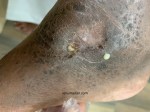
He exhibited more at-risk factors than just suffering from diabetes. He was a chain smoker (smoked 40-50 cigarettes a day) and suffered from alcoholic liver disease with deranged liver and kidney function markers for years.
The picture below was taken after 3 weeks of Homoeopathic medication and lifestyle modifications. The oedema had markedly reduced, the oozing had stopped, the lesion had dried up considerably, and the unbearable foul smell was almost gone. The patient walked in comfortably to my chamber.

He was kept on medication for nearly a year and a half.
I reached out to this patient for a final follow-up (just in case his stasis dermatitis flared up again) some time ago and requested a photograph. He was more than happy to oblige. This is how his foot looked post the final cure.


 Dr Renu Madan
rare incidence i must say
LikeLike
Hello Dr. Madan,
I have a similar growth on the front of my tongue. I would appreciate the opportunity to discuss homeopathic treatment.
LikeLike
Thanks for contacting us.
You can take an appointment at 011 49876010 or 9953166010 during 11-1 pm for a consultation.
LikeLike
Yes, I am a severe sufferer and can confirm this is a hellish existence I would not wish upon my worst enemy and I am suicidal all day every day but refusing to give up, continuing to seek help, do my own research and I trust that eventually something has to give way and I will be healed.
LikeLiked by 1 person
Thanks for writing to us.Please let us know how can we help you.
LikeLiked by 1 person